Vertical obsession
Three years of moss poles, aerial roots, and learning what plants are actually capable of.
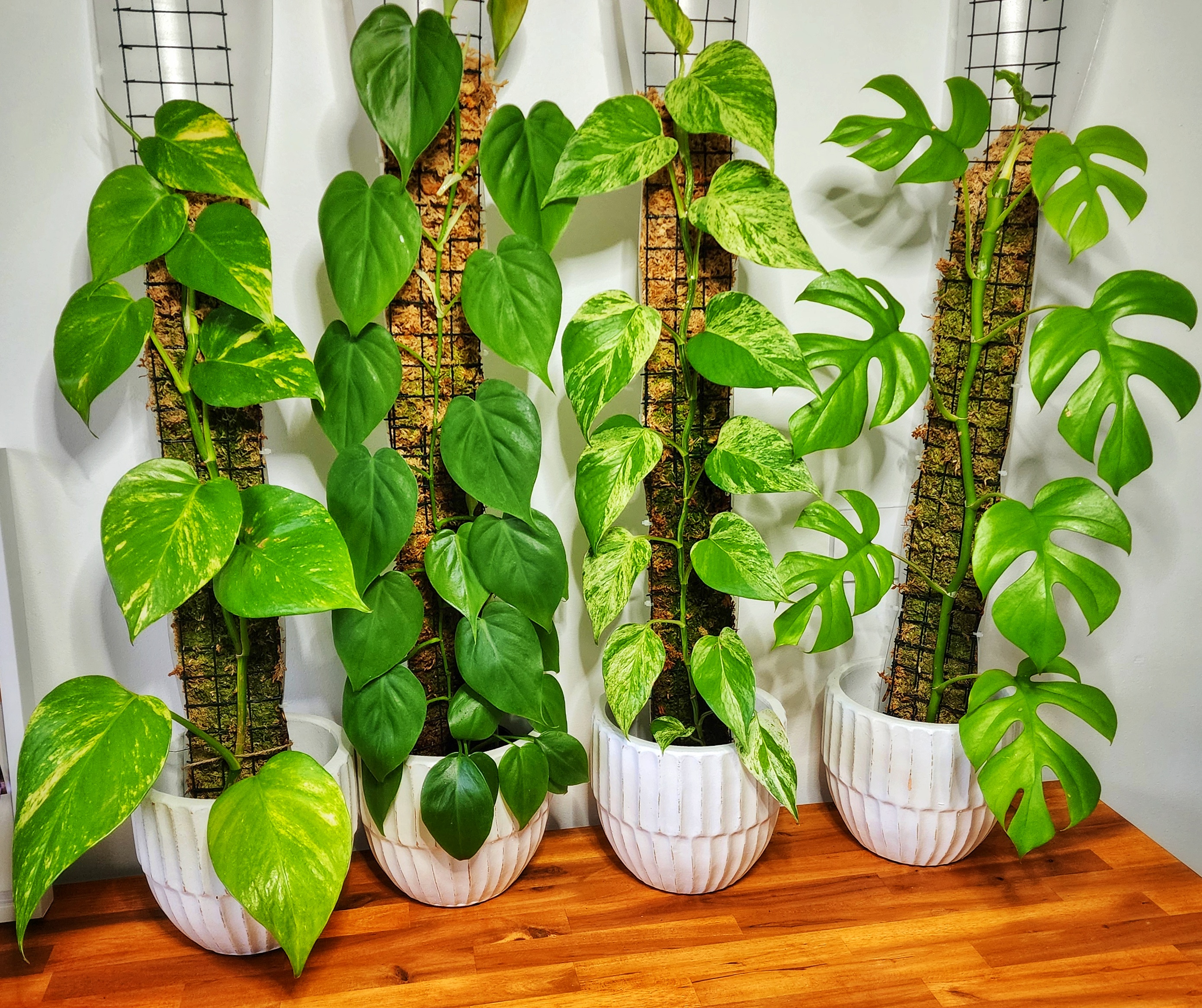
Left to right: Golden Pothos, Philodendron Scandens, Marble Queen, and Rhaphidophora — four climbers, four poles.
About three years ago I noticed something that, once I saw it, I couldn't unsee. Almost every houseplant sold in a nursery — every aroid, every climber, every tropical vine — was being displayed in a way that had nothing to do with how it actually wants to grow.
Flat in a pot. Hanging in a basket. Or if it had support, a thin bamboo stake that barely kept it upright. Technically alive. Sometimes beautiful. But nowhere near what it could be.
I started reading about how these plants actually grow in the wild. Monsteras climbing rainforest trees. Pothos scrambling up through the canopy, chasing light. Rhaphidophoras attaching themselves to bark and pulling themselves upward, leaf by leaf. And I realised: we almost never see this. Not because it isn't possible — but because no one had given them anything to climb.
When a plant finally gets to climb — really climb, into something it can grip — it stops looking like a houseplant and starts looking like what it actually is.
That was the beginning of an obsession that hasn't really let up. I wanted to see what these plants could actually do. And the answer, it turns out, is quite a lot.
Where it started
These are the two that started everything — a golden pothos and a Rhaphidophora, both on their first poles, both just beginning to orient upward. Small leaves. No idea yet what either of them would become.
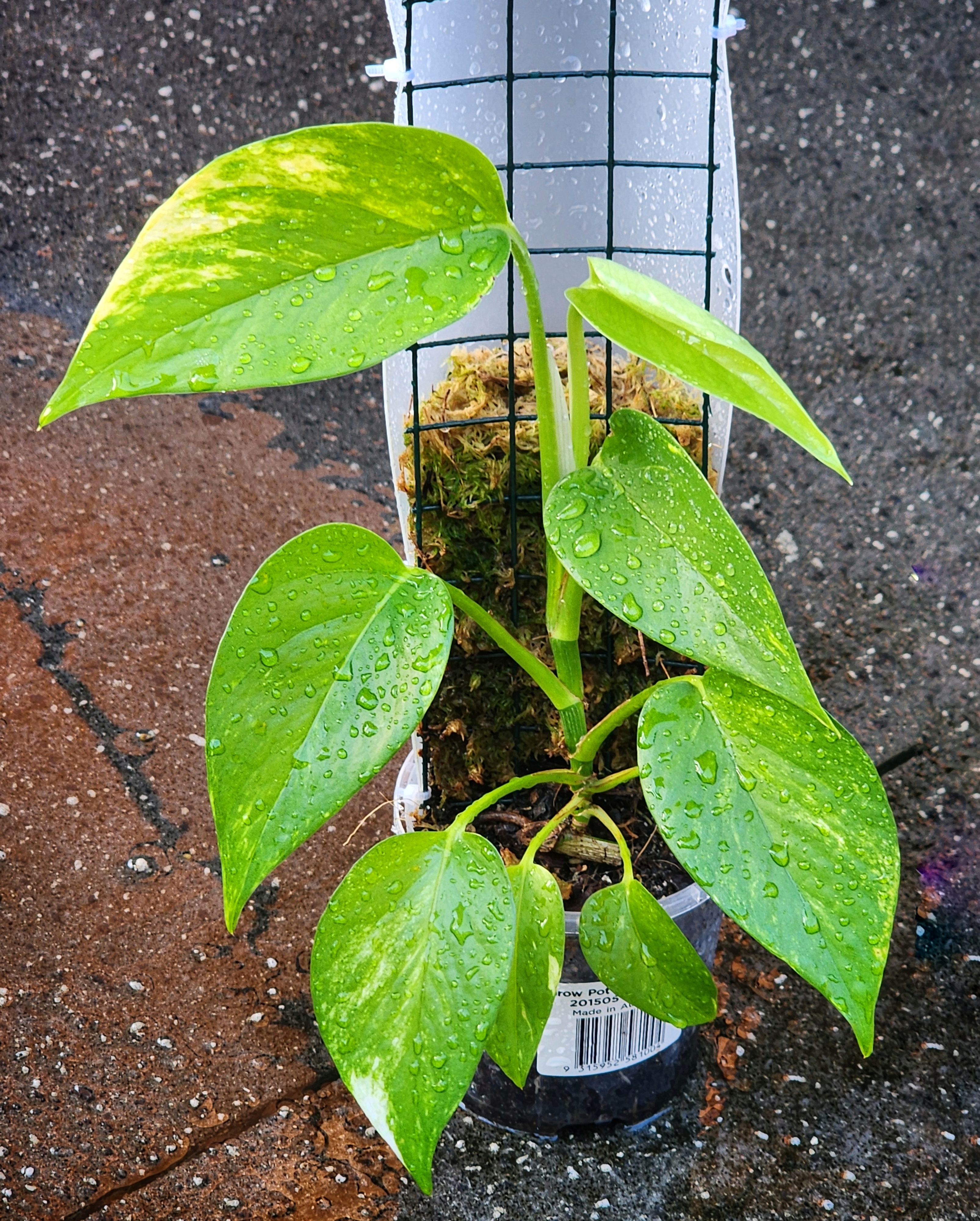
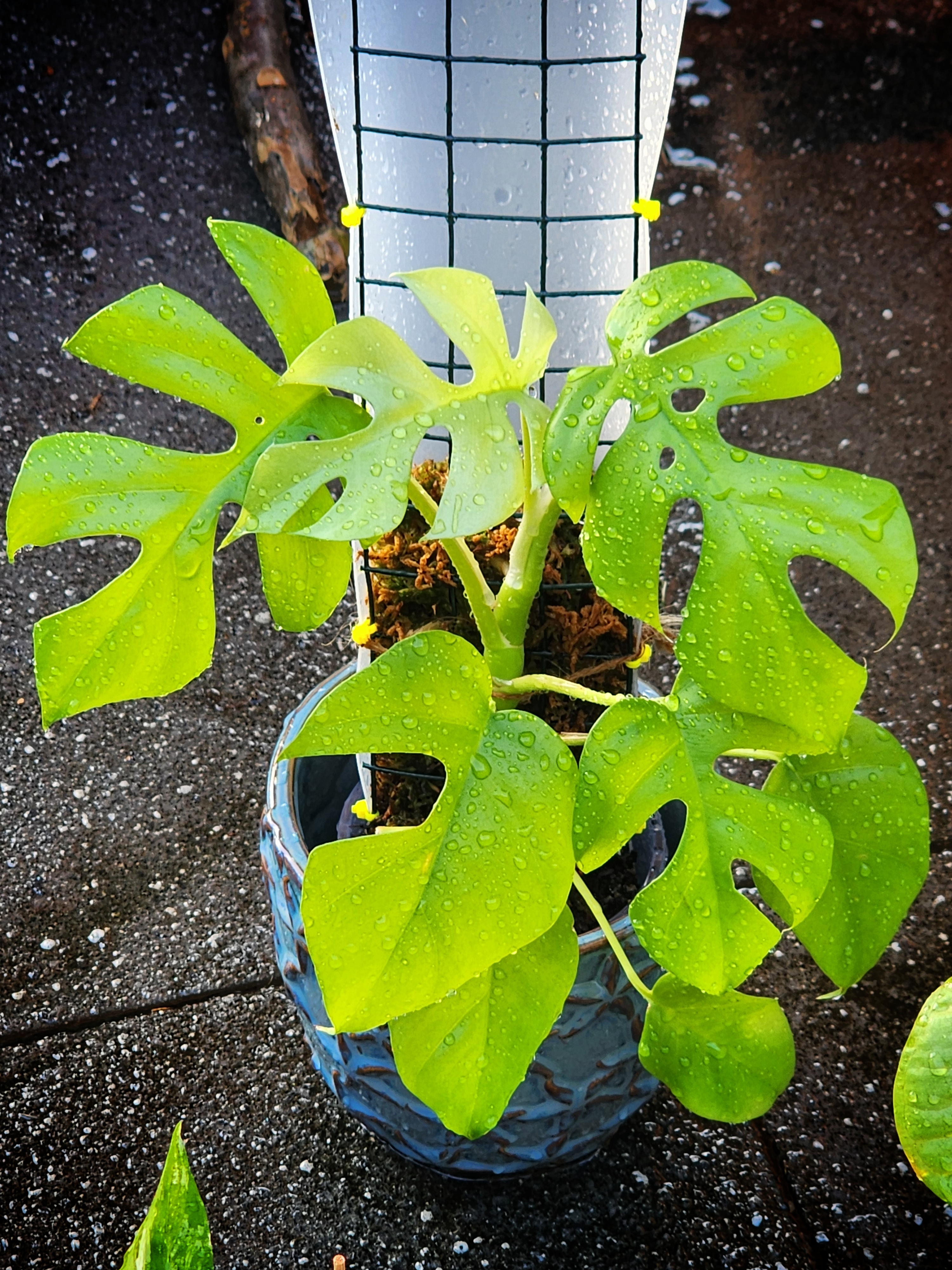
Left: golden pothos on its first pole. Right: Rhaphidophora tetrasperma — both just getting started.
There is something about giving a plant its first real support and watching it orient toward it — the way a new stem leans slightly, then commits — that I find deeply satisfying. The plant knows what to do. It just needed the conditions to do it.
Patience is the hardest part of this, especially at the beginning. You set up the pole, keep the moss humid, position the plant toward the light, and then you wait. Sometimes for weeks before you see any real response. The plant is doing things underground and in its root system that you can't see yet. You have to trust the process.
What changes when a plant climbs
The most visible change — the one that still stops me every time — is fenestration. Those splits and holes that make aroids so striking don't appear just because a plant is mature. They appear because it's climbing. A Rhaphidophora growing flat on a shelf will produce small, solid leaves indefinitely. Give it something to grip and climb, and within a few growing seasons the new leaves begin splitting, developing their characteristic cuts and windows, and arriving at a size that looks nothing like the baby plant you started with.
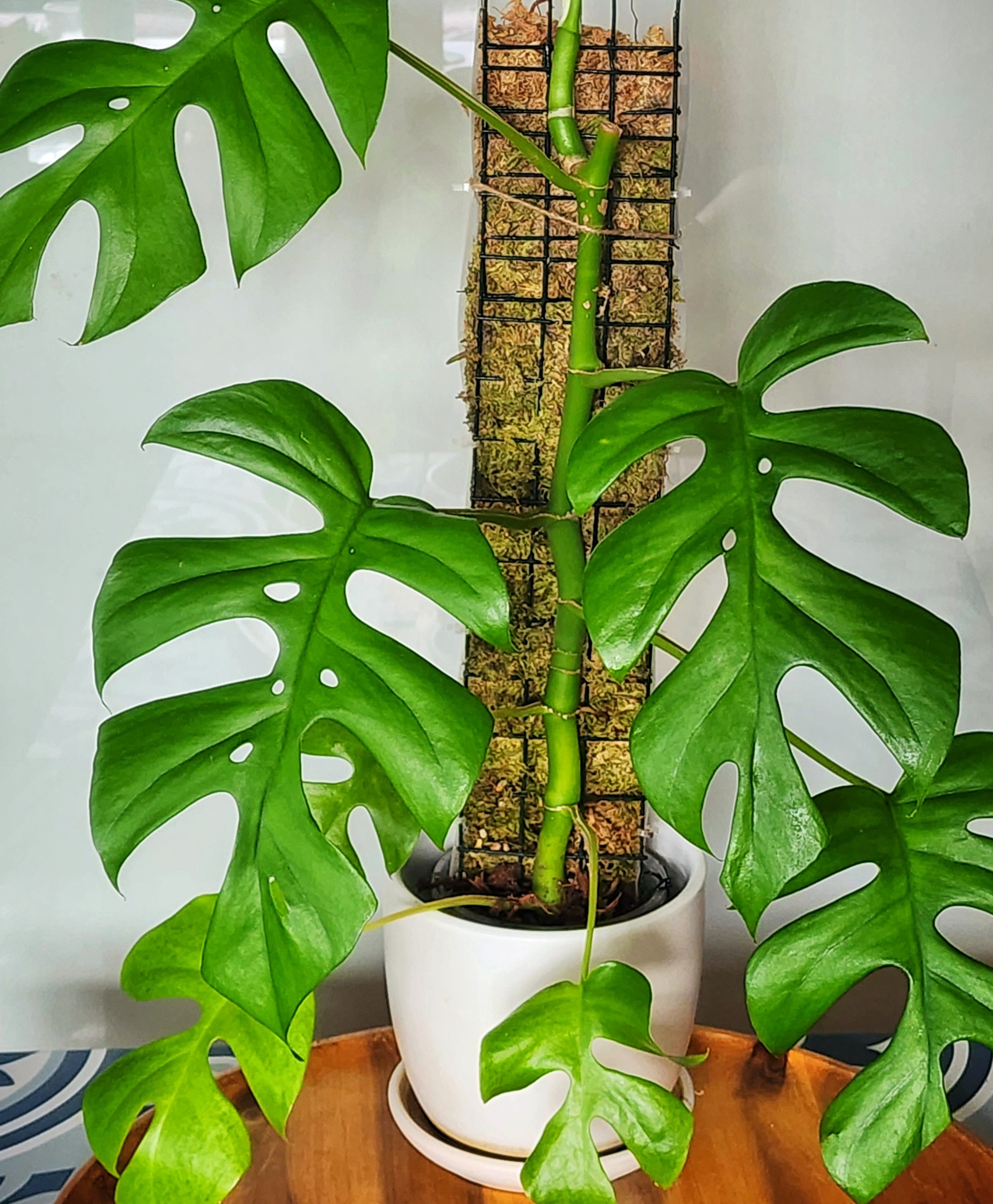
Rhaphidophora tetrasperma beginning to fenestrate — those splits only happen when the plant is climbing.
It's the same plant. Different conditions. Completely different result.
Leaf size follows the same pattern. Plants growing horizontally produce conservative, compact leaves. The same plant climbing a moss pole will push out leaves dramatically larger — and more structurally interesting — within the same growing season. Monstera leaves that would stay solid and small on a shelf will begin splitting deeply once the plant has something real to climb toward.
And then there are the aerial roots.
The roots are the whole story
Aerial roots are the part of this that I find genuinely fascinating. On a flat-grown plant they dangle uselessly or curl back on themselves — a vestigial feature with no job to do. On a climbing plant, they reach out, find the moss, anchor in, and start absorbing moisture directly. You can see it happening through the clear pole. Thin green threads navigating through the sphagnum, branching, deepening, finding their way.
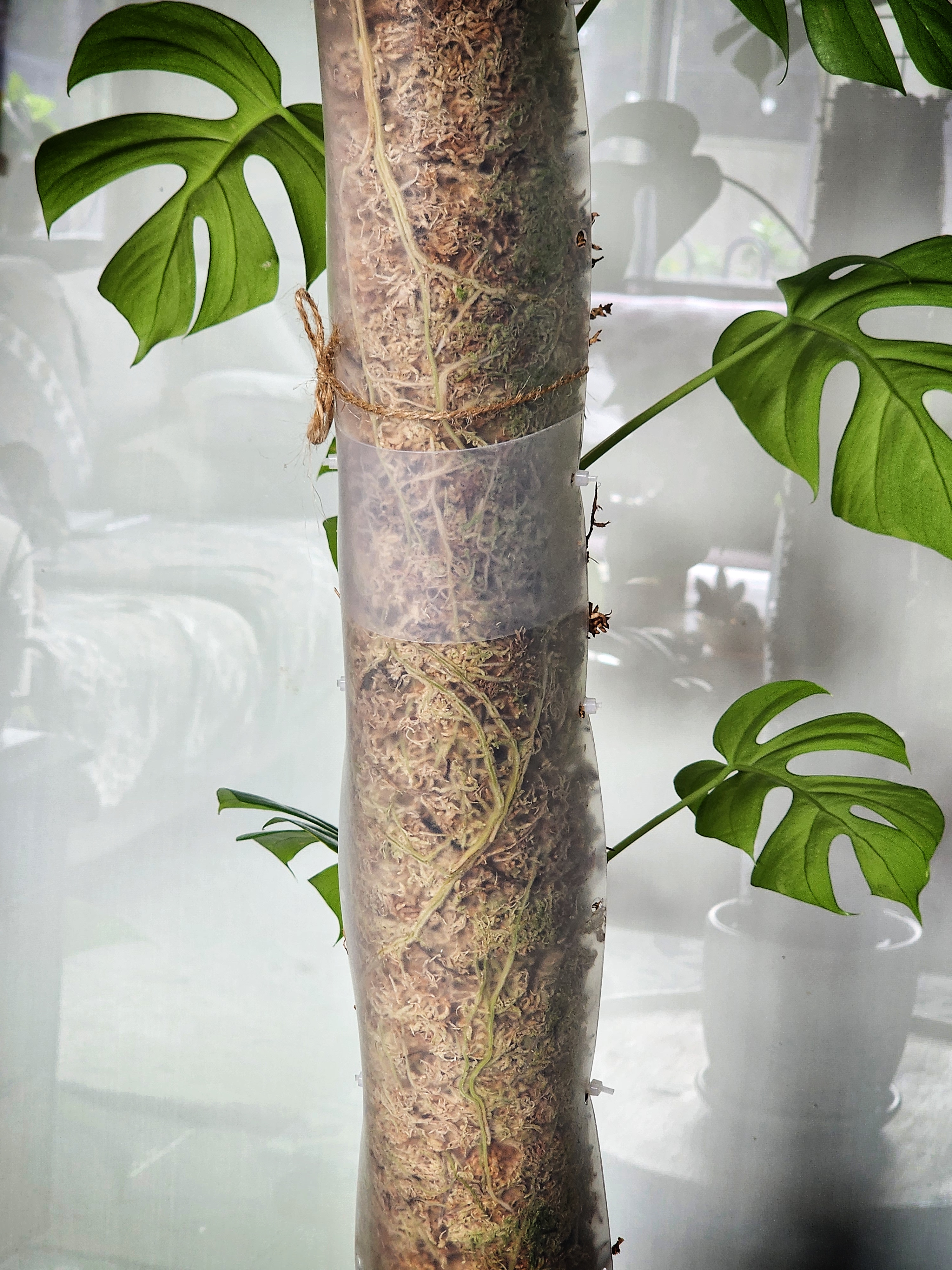
Months of patient climbing, visible through the clear pole. The roots know exactly where to go.
Once the roots are properly anchored, the whole plant behaves differently. More stable, more vigorous — as though it's finally doing what it's supposed to do, drawing moisture and nutrients from two directions at once. The pole isn't just support. It becomes part of the root system.
This is why sphagnum moss matters more than coco coir for this kind of setup. Coco coir gives the roots something to grip, but it doesn't hold moisture the same way. Sphagnum stays damp longer, releases humidity slowly, and mimics the conditions these plants evolved in — bark covered in moss, in a rainforest. The aerial roots know exactly what to do with it.
What actually changes when a plant climbs
Fenestration — leaf splits and holes appear and deepen as the plant climbs higher. Leaf size — new leaves emerge noticeably larger than on flat-grown specimens of the same plant. Aerial roots — anchor into the moss rather than dangling; the plant draws moisture directly from the pole. Variegation — on variegated plants, contrast becomes more pronounced with better light and vigour. Growth rate — a climbing plant with humid roots tends to push new leaves more consistently.
The before and after
The same Rhaphidophora. The same conditions — moss, humidity, patience. Just time. This is what three years of growing vertically looks like on one plant.
.jpeg)
Same plant. Same care. The difference is just what happens when you give it somewhere to go.
The patience part
The thing I wasn't fully prepared for, three years ago, was how much this would ask of me in terms of consistency. A moss pole isn't a set-and-forget addition. It's a commitment. The plant depends on you to keep the conditions right — the humidity, the light positioning, the watering rhythm — for months before you start seeing the results you're working toward.
I water the pole directly, not just the soil. Sometimes with a spray bottle along the full length, sometimes pouring slowly from the top and letting it wick through. Over time you develop a feel for it. You can tell by looking whether the moss is at the right humidity. The plant tells you too, in its own quiet way — a slightly slower growth rate, an aerial root that retreats rather than advances.
There were plants that took their time. Poles that dried out faster than expected in summer. Roots that went in unexpected directions and had to be gently guided back. The learning curve is real. Every plant teaches you something new.
The patience this asks for isn't so different from quilling a letter or drawing a mandala. You can't rush the part that takes time. You keep the conditions right and trust the process.
Three years in, I'm still learning. But watching a new fenestrated leaf unfurl — or seeing roots thread deeper into the moss than they were last week — that hasn't gotten old. It probably won't.
The plants in the shop have been through this process. They've been climbing for a while. They know what to do with a pole. They're ready for somewhere new.
If you are curious about the moss poles these little ones are destined for, the workshop waitlist is open — you can add your name and I will let you know when sessions are running.